Top Smart Solar Street Lights: How Does Dimming Save Energy?
Smart solar street lights combine LED efficiency, photovoltaic power, batteries, sensors, and digital controls. Their main advantage is not brightness alone. It is controlled brightness at the right time. The International Energy Agency reports that lighting uses roughly 10% of global electricity. The U.S. Department of Energy also identifies LED technology and connected controls as major opportunities for reducing lighting demand. These findings support smarter public lighting, but they do not guarantee identical savings in every project.
How do smart solar street lights save energy with dimming? After sunset, a controller can maintain full output near busy roads and intersections. Later, it may reduce brightness when traffic and pedestrian activity decline. A 100-watt lamp might operate at 70 watts during quiet hours, while sensors restore brighter lighting when movement appears. This lowers battery discharge and can preserve power before dawn. It may also reduce the required solar panel and battery capacity. Small changes matter.
Still, the percentage savings require careful measurement. Road classification, weather, battery condition, mounting height, and local safety requirements all influence performance. CIE 115 guidance stresses that adaptive road lighting should match traffic conditions while preserving appropriate visibility. A poorly programmed schedule can create dark areas, shorten battery life, or reduce public confidence. That uncomfortable possibility deserves attention. Real projects should record energy consumption, illuminance, traffic patterns, and fault data before and after installation. The best systems are not simply the dimmest. They are responsive, tested, and properly maintained.
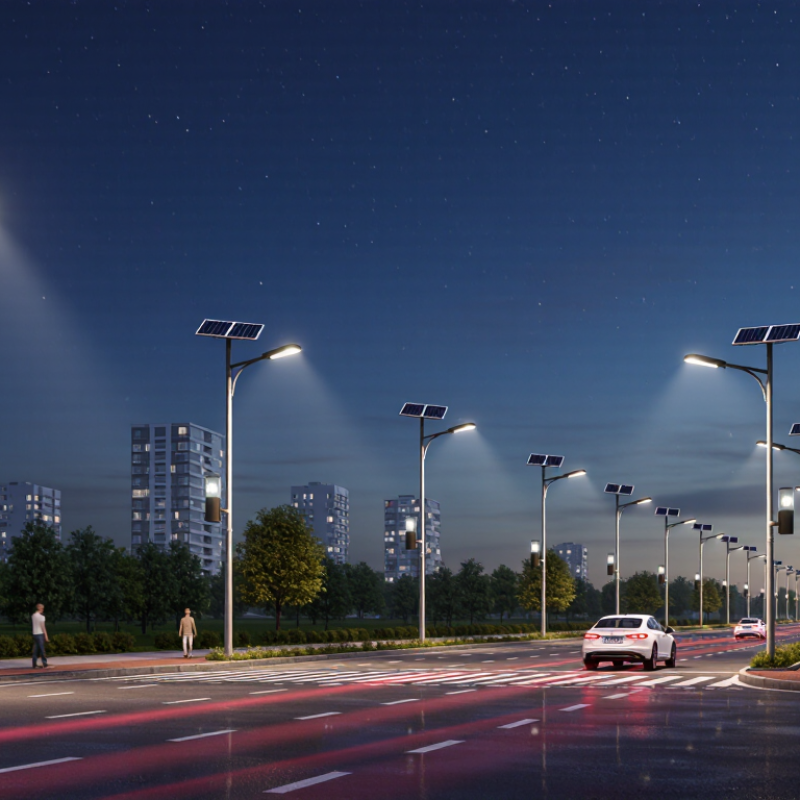
Smart solar street lights are standalone outdoor fixtures designed to produce, store, and manage electricity after sunset. They combine a solar panel, rechargeable battery, LED lamp, controller, and sensors. Unlike basic solar lamps, smart models can respond to motion, ambient light, schedules, or remote settings. A quiet walkway may receive gentle lighting at midnight. When a cyclist approaches, the lamp can brighten within seconds. This makes the system responsive rather than wasteful. Good designs can also report battery status and faults, helping maintenance teams detect problems early. Still, “smart” does not guarantee reliability. Shade, dust, cold weather, and poor sizing can reduce performance.
Dimming saves energy by reducing LED power during low-traffic periods. A light running at 40% output uses less power than full brightness. Exact savings depend on the driver and control system. Lower demand can extend battery runtime through long winter nights. It may also reduce charging pressure and support longer component life. During site planning, engineers should check traffic patterns, mounting height, road speed, and local lighting requirements. A setting that looks efficient on paper may feel too dark near crossings. The first setting is rarely perfect.
How Do Smart Solar Street Lights Work?
Smart solar street lights collect sunlight through photovoltaic panels during the day. A charge controller stores that energy in a lithium battery. After dusk, the controller powers an efficient LED module. Sensors detect movement, traffic, and ambient light. The lamp can remain at 30% brightness, then rise to 100% when a person approaches. This simple change reduces battery demand and extends lighting hours.
The International Energy Agency reports that lighting represents about 15% of global electricity use. The U.S. Department of Energy also notes that LED lighting can use at least 75% less energy than incandescent technology. Solar systems avoid grid electricity, but performance depends on panel angle, battery size, dust, and local weather. Cloudy weeks expose weak assumptions. A larger battery is not always the best answer. It can increase cost and replacement impacts.
Tips: Check winter sunlight before installation. Keep panels clear of leaves and dust. Set dimming levels after observing real traffic, not guesses. Use remote monitoring to track battery voltage, charging status, and nighttime faults. In field inspections, a small shadow from a nearby tree can reduce daily charging more than expected. The design must fit the street, not only the specification sheet.
Hourly LED power demand during a 12-hour night using adaptive dimming
This example uses a 40 W LED street-light fixture. At full brightness for 12 hours, it consumes 0.48 kWh per night. The adaptive profile shown uses 100% brightness during active periods, reduces output to 50–70% during normal traffic, and operates at 30% during low-traffic hours. This schedule consumes approximately 0.29 kWh per night, saving about 40% compared with constant full-power operation.
Adaptive dimming adjusts streetlight brightness according to time, movement, and surrounding conditions. Instead of running at full power all night, lights can operate at 30% or 50% brightness during quiet hours. A controller may raise brightness when a pedestrian, cyclist, or vehicle enters the detection zone. At 11 p.m., an empty road may need less light than a busy evening street. This reduces electricity use and can extend LED service life. Dark paths need care.
The savings depend on accurate settings and local traffic patterns. A poorly aimed sensor can trigger unnecessary brightness, wasting energy. Heavy rain, tree movement, or parked vehicles may also create false signals. In practical installations, technicians should compare energy data before and after dimming. They should also inspect lighting levels on sidewalks, crossings, and corners. Safety must guide every adjustment. The system is not perfect, and fixed schedules may sometimes perform better.
Tips: Begin with a moderate dimming level, then adjust it after several weeks of monitoring. Keep higher brightness near crossings and sharp bends. Clean sensors regularly. Record traffic, battery performance, and night-time complaints. A small trial area can reveal problems before wider installation.
Smart solar street lights reduce energy use by matching light output with real conditions. The main control technologies are sensors, embedded controllers, dimming drivers, and wireless communication.
A photocell measures surrounding brightness and prevents daytime operation. An astronomical clock estimates sunset and sunrise from location and calendar data. Motion sensors then detect pedestrians, bicycles, or vehicles near the pole. Passive infrared sensors work well for people, while microwave radar can detect movement through light rain. The controller may raise brightness from 30% to 100% for several minutes. Then it lowers output gradually. This avoids sudden glare and saves battery power.
The LED driver determines how smoothly dimming occurs. Pulse-width modulation adjusts the light’s operating time, while constant-current control maintains stable brightness and color. Solar controllers also monitor battery voltage, charging current, and temperature. When battery charge falls dangerously low, the system can reduce output automatically. Wireless networks allow operators to change schedules or review faults remotely. However, communication failures still happen. A reliable system must continue using local schedules without a network connection.
During field testing, technicians should compare sensor readings with a lux meter and inspect several nights of operation. A setting that saves energy may create dark areas beside a road. That needs correction. Dimming is not simply “less light.” It is a balance between visibility, battery capacity, traffic patterns, and public safety.
| Dimming Technology or Control Method | Control Signal or Input | How It Controls the Light | Typical Application | Energy-Saving Contribution | Important Design Considerations |
|---|---|---|---|---|---|
| Astronomical Timer | Pre-programmed sunset and sunrise schedule based on date and location | Changes the LED output at defined times, such as full output during peak traffic and reduced output after midnight. | Roads, residential streets, parking areas and pathways with predictable night-time activity | Can reduce unnecessary full-power operation during low-use hours. The actual saving depends on the selected dimming schedule. | Time settings should be updated for seasonal changes. A real-time clock or controller with a location-based schedule improves accuracy. |
| Photocell Sensor | Ambient light level measured by a dusk-to-dawn photosensor | Turns the light on when ambient illumination falls below a threshold and turns it off when daylight returns. | Basic automatic night operation for standalone solar street lights | Prevents daytime operation and avoids energy waste caused by fixed on/off schedules. | The sensor should be positioned away from the luminaire’s own light. Threshold hysteresis helps prevent unwanted switching near dawn or dusk. |
| PIR Motion Sensor | Infrared detection of moving people, bicycles or vehicles | Keeps the light at a lower standby level and raises output when movement is detected, then returns to the lower level after a delay. | Pedestrian paths, cycleways, parks, residential roads and low-traffic areas | Especially effective where activity is intermittent because full output is used only when movement is present. | Detection performance is affected by mounting height, temperature, movement direction, vegetation and the required detection zone. |
| Microwave or Radar Sensor | Microwave reflection from moving objects | Detects motion and adjusts the LED output without relying on heat signatures. | Vehicle roads, loading areas and locations where long-range or through-weather detection is useful | Enables demand-based lighting and can maintain a low background level between traffic events. | Detection zones must be configured carefully to reduce false triggers from nearby roads, fences or moving vegetation. |
| 0–10 V Analog Dimming | Low-voltage analog control signal, commonly ranging from 0 to 10 volts | The controller changes the LED driver’s output level according to the control voltage. | Simple scheduled or sensor-based dimming systems | Provides a straightforward way to reduce LED output during low-demand periods. | Signal wiring, voltage drop, minimum dimming level and driver compatibility must be checked during system design. |
| Digital Addressable Dimming | Two-way digital commands, such as those defined by the IEC 62386 lighting-control framework | The controller can set light levels, read status information and identify certain faults through digital communication. | Smart street-light networks requiring individual control, monitoring and diagnostics | Supports accurate dimming profiles and operational feedback, helping reduce over-lighting and maintenance-related energy use. | Compatibility between the LED driver, controller, wiring architecture and communication protocol is essential. |
| PWM Dimming | Pulse-width modulation signal | Rapidly switches the LED current on and off. The proportion of on-time, called the duty cycle, determines average light output. | Integrated solar-light controllers and LED drivers designed for digital intensity control | Can provide repeatable light levels and maintain consistent LED color performance when properly designed. | PWM frequency, driver design, electromagnetic compatibility and possible camera-flicker requirements should be considered. |
| Constant-Current Reduction | Reduced regulated current supplied to the LED module | Decreases LED current directly rather than rapidly switching the LED on and off. | Low-flicker applications and systems using LED drivers with current-regulation control | Reduces optical output and electrical input power while supporting stable operation at lower output levels. | The LED module and driver must support the required current range. Very low current levels may affect minimum light output or regulation accuracy. |
| Central Wireless Management | Wireless commands, scheduled profiles, sensor data and system alarms | A remote management platform applies dimming schedules to individual lights or groups and can adjust settings based on operating conditions. | Large streets, campuses, municipal areas and connected solar-light installations | Allows site-wide optimization, adaptive schedules and verification of whether the intended dimming profile is actually operating. | Network coverage, cybersecurity, controller power consumption and communication reliability should be included in the design. |
| Adaptive Multi-Level Dimming | Combination of time, motion, ambient-light and battery-state inputs | Uses different output levels throughout the night, for example higher output in the evening, reduced output after midnight and increased output when motion is detected. | Solar street lights with variable traffic patterns and limited battery capacity | Often provides the greatest practical saving because it matches light output to actual demand while protecting late-night battery reserve. | The control logic should include minimum safety levels, transition times, battery protection limits and recovery behavior after cloudy days. |
| Illustrative Energy Calculation | 100 W LED luminaire operating for 12 hours per night | At full output for the entire period: 100 W × 12 h = 1.20 kWh per night. | Example schedule: 100% output for 4 h, 50% for 4 h and 30% for 4 h | Idealized LED-load energy: 0.40 + 0.20 + 0.12 = 0.72 kWh per night, equal to an estimated 40% reduction compared with 1.20 kWh. | This is a planning example. Actual savings will be lower or higher depending on driver efficiency, controller consumption, battery charging losses and the relationship between dimming level and input power. |
| Technical note: LED input power is approximately proportional to light output over a normal dimming range, but it is not perfectly linear because of LED-driver losses and standby consumption. Dimming should therefore be verified using measured luminaire input power rather than calculated from light level alone. Control interfaces and digital dimming practices should be checked against the relevant equipment specifications and applicable lighting-control standards. | |||||
Choosing top smart solar street lights starts with a careful site survey. Measure road width, pole spacing, traffic levels, and nearby shade. Trees can reduce charging more than expected. Check the panel’s wattage, battery capacity, and lighting output together. A large panel cannot fix a weak battery.
Look for adaptive dimming, motion sensing, and remote monitoring. Dimming lowers brightness during quiet hours, saving stored energy for cloudy mornings. It should increase brightness quickly when pedestrians or vehicles appear. Ask for tested illumination data, not only impressive marketing numbers.
In field inspections, I also check the light pattern on the pavement. Bright poles may still leave dark gaps. That detail is easy to miss.
Choose weather-resistant housing, secure connectors, and a battery rated for local temperatures. Independent test reports and a clear warranty improve reliability. A replaceable battery is useful after several years.
I once focused too much on panel size and ignored maintenance access. That was a costly mistake.
Request a small pilot installation before covering the whole road. Compare overnight brightness, charging performance, and remote alerts for several weeks. Keep records. Real conditions often challenge the original design.
It lowers brightness during quiet hours instead of running lights at full power all night. A road at 11 p.m. may need only 30% brightness. Motion sensors raise the light when people, bicycles, or vehicles appear.
Lower brightness can reduce operating stress and extend LED service life. The actual result depends on settings, weather, and usage patterns. The system is not perfect.
Poorly aimed sensors may detect tree movement, heavy rain, or parked vehicles. These false signals increase brightness without real traffic. Regular sensor checks can reduce wasted energy.
Start with moderate dimming and monitor the area for several weeks. Check sidewalks, crossings, corners, energy use, and night-time complaints. Safety must guide each adjustment.
Measure road width, pole spacing, traffic levels, and nearby shade. A large tree can reduce charging more than expected. Site conditions matter.
Assess panel wattage, battery capacity, and lighting output together. A large panel cannot compensate for a weak battery. Local temperatures also affect battery performance.
Motion sensing, adaptive dimming, and remote monitoring can improve control. Weather-resistant housing and secure connectors help protect outdoor equipment. A replaceable battery may simplify future maintenance.
A small trial can reveal dark pavement gaps, weak charging, or missing remote alerts. Compare brightness and battery performance for several weeks. Test before expanding.
Focusing only on panel size can hide poor maintenance access or weak lighting coverage. I once overlooked maintenance access. That mistake was costly.
Compare energy data before and after dimming. Record traffic, brightness, charging results, battery behavior, and complaints. Marketing figures alone are not enough.
Smart solar street lights combine solar panels, batteries, LED lamps, sensors, and intelligent controllers to provide reliable outdoor lighting without depending entirely on the electrical grid. During the day, solar panels collect energy and store it in batteries. At night, the controller powers the LEDs according to programmed schedules, weather conditions, battery levels, and real-time activity. This makes the system more flexible and efficient than conventional street lighting.
How do smart solar street lights save energy with dimming? They adjust brightness according to pedestrian, bicycle, or vehicle movement. When no activity is detected, the lights can operate at a lower output, then brighten quickly when motion appears. Technologies such as motion sensors, microwave or infrared detection, wireless communication, timers, and centralized monitoring help manage these changes. When choosing top smart solar street lights, consider solar and battery capacity, lighting performance, dimming accuracy, sensor reliability, weather resistance, maintenance needs, and the quality of the control system.

Lumina Light